Worked examples are illustrative and are not sealed engineering documents. Site-specific analysis requires a licensed engineer in the relevant jurisdiction. Regulatory references to other jurisdictions (e.g. California) are descriptive. Valerio Oricchio P.E.
1. The question
Which jurisdiction has the most complete legal framework for automated and connected vehicles, on each continent? And what is actually scheduled between now and 2030?
The technology, the deployment scoreboard and the safety data are a separate subject. This article goes one layer deeper, into the law itself. It asks how each jurisdiction answers the same questions: who approves the vehicle, who permits the service, who is liable, what must be recorded and reported, who gets the ticket when nobody is driving, how remote operation is governed, and what is being done about V2X.
The answer is not the same as “who has the most robotaxis”. The United States leads on operations but has no federal AV statute. Germany has had an operative Level 4 law since 2021 but almost no regular services under it. The UAE has strict operator liability and live regulator telemetry. China is the only country that combines a national approval route, a mandatory safety standard, a draft national law and a large V2X installed base.
This is a status atlas as of 21 October 2026. Section 10 scores a leader per continent on a rubric set out in full; it is my assessment, not an official ranking. Section 11 is a dated roadmap, with each milestone marked announced or expected.
2. How to read AV regulation: the building blocks
Every jurisdiction that wants driverless vehicles on public roads must answer seven questions (Figure 1).
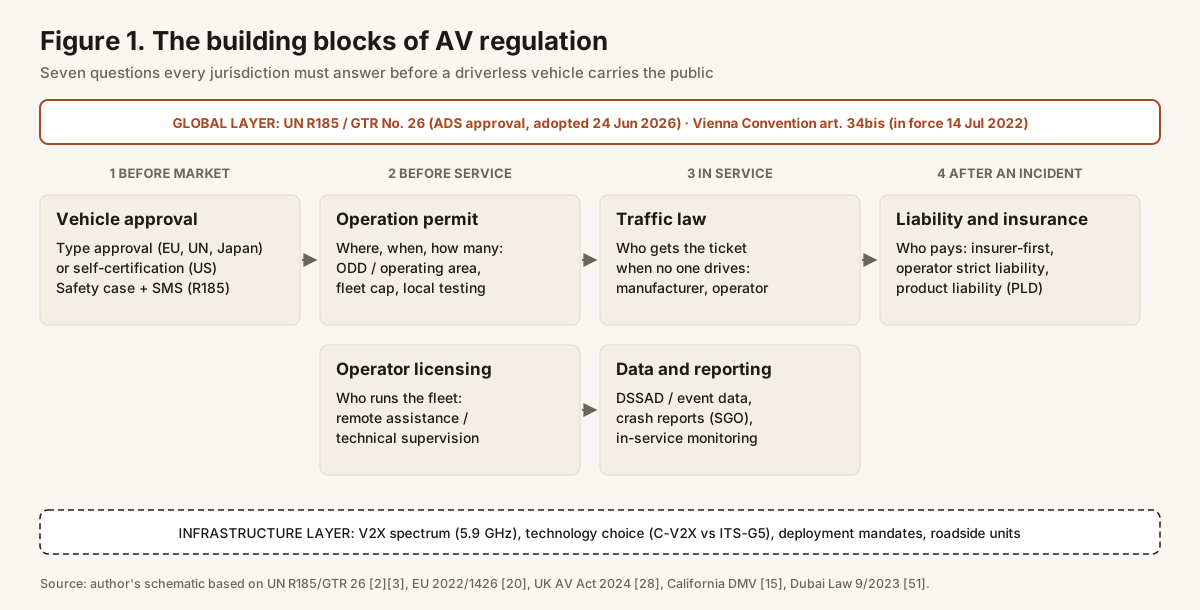 Figure 1. Seven questions, from vehicle approval to liability, sit between a global layer of UN instruments and an infrastructure layer of V2X. Source: author’s schematic based on [2][3][15][20][28][51].
- Vehicle approval. Is the automated driving system (ADS) approved by an authority before sale (type approval), or does the manufacturer certify compliance itself (self-certification)?
- Operation permit. Where, when and at what scale may the vehicle run? This covers the operational design domain (ODD), the operating area, fleet caps and local testing.
- Operator licensing and remote operation. Who runs the fleet, and what remote assistance or “technical supervision” must exist?
- Traffic law. Who receives the ticket when a vehicle with no driver breaks a rule?
- Data and reporting. What must the vehicle record (the Data Storage System for Automated Driving, DSSAD), and what must be reported to whom?
- Liability and insurance. Who pays a victim, and on what basis?
- V2X. Is spectrum assigned, is a technology chosen, and is there a deployment mandate?
The levels used throughout are those of SAE J3016 [1]. At Level 3 a human must take over on request. At Level 4 the system must reach a minimal risk condition by itself.
3. The global layer: UN instruments and road-traffic conventions
UN R185 and GTR No. 26. On 24 June 2026 the UNECE World Forum (WP.29) adopted a UN Regulation and a Global Technical Regulation on ADS [2][3]. UN R185 sits under the 1958 Agreement, which governs mutual recognition of type approvals. GTR No. 26 sits under the 1998 Agreement, which provides a technical baseline that countries such as the US must transpose into their own rules [6][5]. The requirements include:
- an audited Safety Management System across the whole lifecycle;
- a safety case showing that the ADS reaches “at least the level of safety of a competent and careful human driver” [3];
- multi-pillar validation by simulation, track and real-world testing [3][4];
- in-service monitoring, incident reporting and data recording [2][3][5].
Entry into force has not been confirmed. Shoosmiths wrote in July that “the precise timing has not yet been confirmed” [3]. Applied Intuition expected it to take effect “as early as 2027 in type-approval markets” [4]. One secondary headline gives January 2027 [70]; I could not verify that date. For US adoption, NHTSA rulemaking is still required [12].
UN R157 (ALKS). The motorway Level 3 regulation started at 60 km/h. A 2022 amendment raised the limit to 130 km/h [9].
Vienna Convention, art. 34bis. On 14 July 2022 a new article 34bis of the 1968 Vienna Convention on Road Traffic took effect [7]. It treats the requirement for a driver as satisfied while an automated driving system complies with domestic technical regulations and domestic operating legislation [8]. It does not authorize automated driving on its own. Each country must still legislate, including on liability [7]. The United States and China are not parties to the Vienna Convention [8]. Their national law is therefore the only constraint.
Standards. The R185 safety case draws on industry practice in scenario-based testing and safety of the intended functionality (ISO 34502, ISO 21448) and on the UL 4600 safety-case standard. I have not verified how directly each is referenced in the adopted texts, so treat these as context only.
4. North America
United States: federal
The US has no federal AV statute. Federal control works through vehicle standards (FMVSS), exemptions and crash reporting under the Standing General Order [10].
- Approval route. Manufacturers self-certify compliance with the Federal Motor Vehicle Safety Standards (FMVSS), so a vehicle without manual controls needs an exemption or a rewritten standard [10][13].
- Exemptions. On 30 July 2026 NHTSA granted Zoox the first commercial Part 555 exemption, capped at 2,500 vehicles a year, “the maximum under current law” [11]. The cap rises to 5,000 in the second year [76].
- Data and reporting. The amended Standing General Order (SGO) requires serious crashes to be reported within five days, and dockets on remote assistance and first-responder interaction are expected [10][12].
- Enforcement after the fact. NHTSA used a Special Order in September 2026 to test Tesla’s self-certification of the Cybercab [67].
- Congress. The SELF DRIVE Act of 2026 (H.R. 7390) has stalled since February 2026, while the House surface transportation bill would create FMCSA rules for commercial AVs [12][14].
United States: states
States control operation, licensing and traffic law. A 2024 survey counted 19 states that permit AV operation subject to conditions [17]. That count is two years old and should be rechecked.
- California. DMV regulations finalized on 28 April 2026 let police send “notices of autonomous vehicle noncompliance” to manufacturers from 1 July 2026, with a two-minute emergency-geofence rule and a 1,000,000-mile threshold for driverless heavy-duty AVs [15].
- Texas. Under SB 2807, commercial AV operators have needed TxDMV authorization since 28 May 2026 [16].
- Arizona and Florida. Both have statutes permitting operation; Florida requires a “minimal risk condition” after a system failure [17].
Canada and Mexico
Transport Canada published an updated AV safety framework in 2025. Public-road use remains “limited to temporary pilot projects” run by provinces [18]. Ontario’s pilot, running since 2016, had 15 organizations approved to test driverless vehicles as of June 2025. It expires in October 2027 and no successor has been announced [18]. No driverless ride service operates in Canada [18]. Mexico has no federal AV framework and no federal bill [19].
| Building block | United States | Canada | Mexico |
|---|---|---|---|
| Legal basis for driverless ops | State statutes (CA, TX, AZ, FL…) [15][16][17] | Provincial pilots only [18] | None [19] |
| Approval route | Self-certification + Part 555 exemption (2,500/yr) [11] | CMVSS; pilot permits [18] | — |
| Traffic law | CA noncompliance notices to manufacturer [15] | Laws assume a human driver [18] | — |
| Data and reporting | SGO (5-day serious crashes) [10] | Pilot conditions | — |
| Remote operation | Federal dockets pending [12] | Remote operator allowed in Ontario pilot [18] | — |
5. Europe
European Union
- Approval. Regulation (EU) 2019/2144 and Implementing Regulation (EU) 2022/1426 provide EU type approval for the ADS of fully automated vehicles. Approval is limited to 1,500 units per type per year for categories M and N. It covers vehicles in a specified area, on a fixed route between fixed points, or in automated parking [20]. Implementing Regulation (EU) 2026/481, in force since 24 March 2026, removed the registration limit for automated parking systems [21]. The Commission plans a wider type-approval reform for unlimited series, then regulatory sandboxes and automated driving corridors [22].
- Pre-deployment. More than ten Member States agreed on 8 June 2026 to sign a declaration on cross-border AV testbeds. The declaration aims at mutual recognition of approvals and coordinated permitting. The Connecting Europe Facility set aside €20 million for AV digital infrastructure [26].
- Liability. The revised Product Liability Directive (EU) 2024/2853 explicitly covers software, including over-the-air (OTA) updates and AI systems. It presumes a defect where the claimant faces “excessive difficulties, in particular, due to technical or scientific complexity”. Member States must transpose it by 9 December 2026 [24].
- AI Act. Article 109 of the AI Act amends Regulation 2019/2144. When the Commission adopts implementing acts on AI safety components, the AI Act’s high-risk requirements “shall be taken into account” [25]. The effect on vehicles is indirect and runs through type approval.
- C-ITS. The revised ITS Directive (EU) 2023/2661 had to be transposed by 21 December 2025. Binding C-ITS specifications are targeted for 2026–2027 [27].
Germany
Germany’s 2021 Level 4 law (Road Traffic Act, StVG §§1d–1l) and its implementing regulation (AFGBV) allow driverless operation in an approved, geofenced operating area [22]:
- the KBA approves the vehicle and its ODD, using EU type approval as the basis;
- a separate national authority approves the operating area [20];
- a technical supervisor in a control centre must always be available, able to deactivate the vehicle or approve alternative manoeuvres [22];
- keepers have extensive data-storage duties, covering accidents, near-accidents and evasive manoeuvres [22];
- a remote-driving ordinance (StVFernLV), in force since 1 December 2025, replaces case-by-case exemptions for teleoperation with a standard permit route [22].
Even so, “no company has transitioned a Level 4 pilot project into regular operation” [22]. At Level 3 the law exists but the products are retreating: BMW said in February 2026 it will discontinue its Level 3 system [66].
France
Decree 2021-873 of 29 June 2021, applicable from 1 September 2022, created the framework for automated road transport systems (STRA) on predefined routes or zones [23][73]. Fully automated systems must be supervised by a person in charge of remote intervention [23]. Approval rests on two safety demonstrations, one by the system designer and one by the transport organiser, each reviewed by qualified bodies approved by the STRMTG, the national guided-transport safety agency [73]. An annual external audit report and serious-accident reports go to the prefect, the police authority and the road manager [23].
Ordinance 2021-443 of 14 April 2021 sets the criminal-liability rules. While the delegated-driving system has dynamic control, the driver is not criminally liable for offences resulting from its manoeuvres. The manufacturer or its representative answers for involuntary-harm offences if fault is established and pays the fine for minor offences. For automated road transport systems the service organiser or operator bears the same liability, and the remote operator answers for their own interventions [74].
United Kingdom
The Automated Vehicles Act 2024 received Royal Assent on 20 May 2024 [71]. It creates authorization for self-driving vehicles. An authorised self-driving entity (ASDE) is responsible for the vehicle’s driving and must meet requirements on financial standing and repute. A licensed operator must supervise any journey with no user in charge [28].
- Liability. Under the Automated and Electric Vehicles Act 2018, victims claim directly against the insurer even with no driver [28].
- Passenger services. The Automated Passenger Services (APS) permit regulations came into force on 15 May 2026. As of September, “No operator has completed even the first stage of the APS approval process in London” [30].
- Safety standard. A draft statement of safety principles was published on 17 June 2026. It sets the bar at “careful and competent human drivers”. After consultation closed in September, it is to be laid before Parliament in 2027 [29].
- Full implementation of the Act is planned for the second half of 2027 [28].
| Building block | EU | Germany | France | UK |
|---|---|---|---|---|
| Legal basis | GSR + 2022/1426 [20] | StVG L4 + AFGBV (2021) [22] | Decree 2021-873 [23] | AV Act 2024, staged to H2 2027 [28] |
| Approval | EU ADS type approval, 1,500/type/yr [20] | KBA + operating-area approval [20] | Safety demonstrations + AQO review [73] | Authorisation + APS permits [28][30] |
| Liability | PLD 2024/2853 from Dec 2026 [24] | Product liability + PLD [22] | Ordinance 2021-443: maker/operator answers while system drives [74] | Insurer-first (AEVA 2018) [28] |
| Data | R185 DSSAD (pending) [2] | Keeper storage duties [22] | Audit + accident reports [23] | Call for evidence 2025–26 [28] |
| Remote operation | — | Technical supervisor; StVFernLV [22] | Remote intervenor required [23] | Licensed operator for no-user-in-charge journeys [28] |
6. Asia
China
China combines city rules, national product access and a national law in progress.
- City rules. Beijing’s Autonomous Vehicle Regulations, in force since 1 April 2025, cover “Level 3 and higher systems” [31].
- National product access. A pilot launched in November 2023 led to nine automakers being selected in June 2024 [32]. The first Level 3 product approvals came on 15 December 2025, for designated expressway sections at up to 50 and 80 km/h [33].
- Marketing and OTA. In April 2025 MIIT told carmakers to stop using terms such as “autonomous driving” for driver assistance, and to treat emergency OTA updates as recalls [34].
- Mandatory standard. GB 44721—2026, Safety Requirements for Autonomous Driving Systems of Intelligent Connected Vehicles, was approved on 30 July 2026 and becomes mandatory on 1 July 2027 [39]. It covers L3 and L4 systems in categories M and N and sets the bar at “at least as safe as a competent and attentive driver”. It requires a driver-readiness monitor for L3, and checks safety capability across design, production and post-deployment through dossiers and third-party testing [39].
- Draft national law. On 25 August 2026 the State Council submitted a Road Traffic Safety Law amendment with an autonomous-vehicle chapter to the NPC Standing Committee for first reading [35][36][37]:
- if a violation occurs while autonomous driving is active, the manufacturer or importer is responsible;
- according to two reports, a company claiming the system was not involved must prove it; the official summary does not set out evidentiary rules [36][38];
- AVs fall under compulsory motor insurance;
- vehicles must pass road-rule tests and be registered before driving autonomously [38];
- handover cases are left to “future regulation and judicial practice” [37].
- After the Wuhan outage of March 2026, three ministries ordered “safety rectifications” [69]. Reports that new permits were suspended remain unconfirmed [68].
Japan
Japan built its framework in three steps [43]:
- the 2020 revisions of the Road Transport Vehicle Act and Road Traffic Act enabled Level 3;
- Level 4 vehicle safety standards followed in January 2023;
- the April 2023 Road Traffic Act revision created a permit system for “specified automated operation”, meaning driverless operation.
The first Level 4 approval, in Eiheiji, came in March 2023 [42]. The government target is unmanned mobility services at about 50 locations in FY2025 and “100 or more locations by fiscal 2027” [43]. In November 2025 MLIT’s draft update of the national transport plan proposed replacing this with a target of 10,000 Level 4 buses, taxis and trucks by FY2030 [72]. I found no official count of locations achieved in FY2025. Waymo plans public driverless trips in Tokyo in 2027, subject to approvals [44].
South Korea
The Act on Promotion and Support of Commercialization of Autonomous Vehicles has been in force since 1 May 2020. It created pilot zones where vehicles may run under a lighter performance check [46]. The compensation law makes the owner’s insurer pay first, with recourse against the manufacturer for defects, and requires an AV data recorder whose data owners keep for one year [46].
In July 2026, MOLIT issued Level 4 driverless operation guidelines [47]:
- at least 15,000 km of driving records, with takeovers no more frequent than once per 160 km;
- real-time remote monitoring, system redundancy and a passenger emergency stop;
- a minimal-risk strategy that alerts the remote centre.
Amendments to the Automobile Management Act are targeted within 2026 [47]. The commercialization goal is Level 4 “in defined settings by 2027” [48].
Singapore
Fixed-route autonomous shuttles in Punggol opened to the public on 1 April 2026 under LTA monitoring [50]. The release does not set out the legal framework, so Singapore is not scored.
Middle East (part of Asia)
- UAE, federal. Federal Decree-Law No. 14 of 2024 is the first federal law to provide expressly for self-driving vehicles. Its Cabinet implementing decision is still pending [51].
- Dubai. Law No. 9 of 2023 and Administrative Resolution No. 939 of 2025 define six AV categories and fourteen operator obligations, and require local testing in Dubai [51][52]:
- the operator bears strict civil liability, with recourse against the party at fault;
- operators must keep an electronic record of movements, faults and accidents that may not be altered or deleted without RTA approval [51].
- The RTA launched commercial autonomous taxis on 30 March 2026 [53].
- Abu Dhabi. A permit regime run by the Integrated Transport Centre sends telemetry, incident and violation data directly to the regulator [51]. It issued the region’s first two permits for fully driverless commercial operation in November 2025 [51][54].
- Ras Al Khaimah. Law No. 1 of 2026 was added in January [51].
- Saudi Arabia. AV deployments are restricted to the Transport General Authority’s (TGA) regulatory sandbox [55]. A SASO technical regulation for AVs reportedly took effect in April 2026. In June 2026 the Interior Ministry reportedly said driver-authorization rules do not apply to vehicles operating without human intervention, with responsibility on the owner [56]. Both points come from one secondary source and are UNVERIFIED.
| Building block | China | Japan | South Korea | UAE (Dubai) |
|---|---|---|---|---|
| Legal basis | City regs + draft national law [31][35] | Road Traffic Act L4 permit (2023) [43] | AV Act (2020) + L4 guidelines (2026) [46][47] | Law 9/2023 + Res. 939/2025 [51] |
| Approval | MIIT access; GB 44721 from Jul 2027 [33][39] | L4 vehicle standards + operation permit [43] | Temporary operation permit [47] | RTA licence + local testing [52] |
| Who gets the ticket | Manufacturer/importer (draft) [36] | Not verified | Not verified | Operator obligations, fines [51] |
| Liability | Compulsory insurance + maker (draft) [36] | Not verified | Insurer-first, recourse to maker [46] | Operator strict liability [51] |
| Data | Incident data exchange standard to follow [39] | Not verified | AV recorder, 1-year retention [46] | Electronic record, no alteration or deletion without RTA approval [51] |
| Remote operation | Not in draft as reported [36] | Remote monitoring under permit [43] | Real-time remote monitoring [47] | Not addressed directly [52] |
7. Oceania
Australia. The planned national Automated Vehicle Safety Law (AVSL) would put safety responsibility on an Automated Driving System Entity (ADSE), a corporation rather than a human driver. States and territories would make complementary changes [57]. A limited exposure draft of an Automated Vehicle Safety Bill 2026 circulated in September 2026 [58]. The federal government aims to finalise the framework by 2027 [59]. No commencement date has been published [57].
New Zealand. The Land Transport Act 1998 does not legally require a human driver. Trials run through case-by-case exemptions, which the Ministry calls unsustainable at scale [60]. The no-fault Accident Compensation Act 2001 may apply to AV injuries [60].
| Building block | Australia | New Zealand |
|---|---|---|
| Legal basis | AVSL in exposure draft [58] | No driver requirement in statute [60] |
| Approval | Planned ADSE regime [57] | s166 exemptions [60] |
| Liability | ADSE responsibility (planned) [57] | ACC no-fault scheme may apply [60] |
| Timing | Finalise by 2027 (target) [59] | No dates [60] |
8. Latin America
A March 2026 regional survey by CMS found little to score [19]:
- Argentina has federal parameters for autonomous cars, through a traffic-law reform, but no liability rules. The reform is Decree 196/2025 of March 2025, which amended the national traffic-law regulation “to permit the circulation of autonomous-driving vehicles” [75].
- Brazil has Bill 1317/2023 pending; it requires a human able to take control in emergencies.
- Chile has no specific framework in progress; its AI bill would classify AVs as high-risk AI.
- Colombia regulates automated driving systems “up to SAE level 3”.
- Peru and Mexico have no federal bills. Colombia, Peru and Mexico “still lack a regulatory framework and legal certainty” [19].
I found no driverless public service in the region.
| Country | Status [19] |
|---|---|
| Colombia | Regulated up to SAE Level 3; no liability rules |
| Argentina | Federal traffic-law parameters; no liability rules |
| Brazil | Bill 1317/2023 pending |
| Chile | Testing encouraged since 2021; AI bill |
| Mexico, Peru | No federal framework |
9. Africa
I found no African AV statute. In South Africa, an industry source said in March 2026 that “autonomous vehicles cannot even enter the roads until these regulations are in place” [61]. One outlet reported that Baidu Apollo would start trials of 30 robotaxis in Cairo in October 2026, in partnership with Egypt’s Ministry of Transport [62]. That report is UNVERIFIED. The legal basis was not stated.
| Country | Status |
|---|---|
| Egypt | Ministry-partnered robotaxi trial reported for Oct 2026 (UNVERIFIED) [62] |
| South Africa | No AV regulations; AVs not permitted [61] |
10. Scorecard: the leader on each continent
Rubric (author’s assessment). I scored each jurisdiction from 0 to 3 on six criteria, for a maximum of 18:
- A. Legal basis for driverless operation. 0 none; 1 pilots or exemptions; 2 enacted but partial or staged; 3 operative.
- B. Approval route. Is there a defined route from vehicle to service?
- C. Liability clarity. Is it clear who pays and who answers for violations?
- D. Data and reporting. Are recording and incident reporting mandatory?
- E. Operations at scale. 0 none; 1 supervised or small; 2 driverless commercial; 3 thousands of driverless vehicles.
- F. V2X readiness. Spectrum, technology choice, deployment targets, and installed roadside base.
Where scores tie, the jurisdiction with a published bill or law in progress leads. Where a fact was unverified, I scored conservatively.
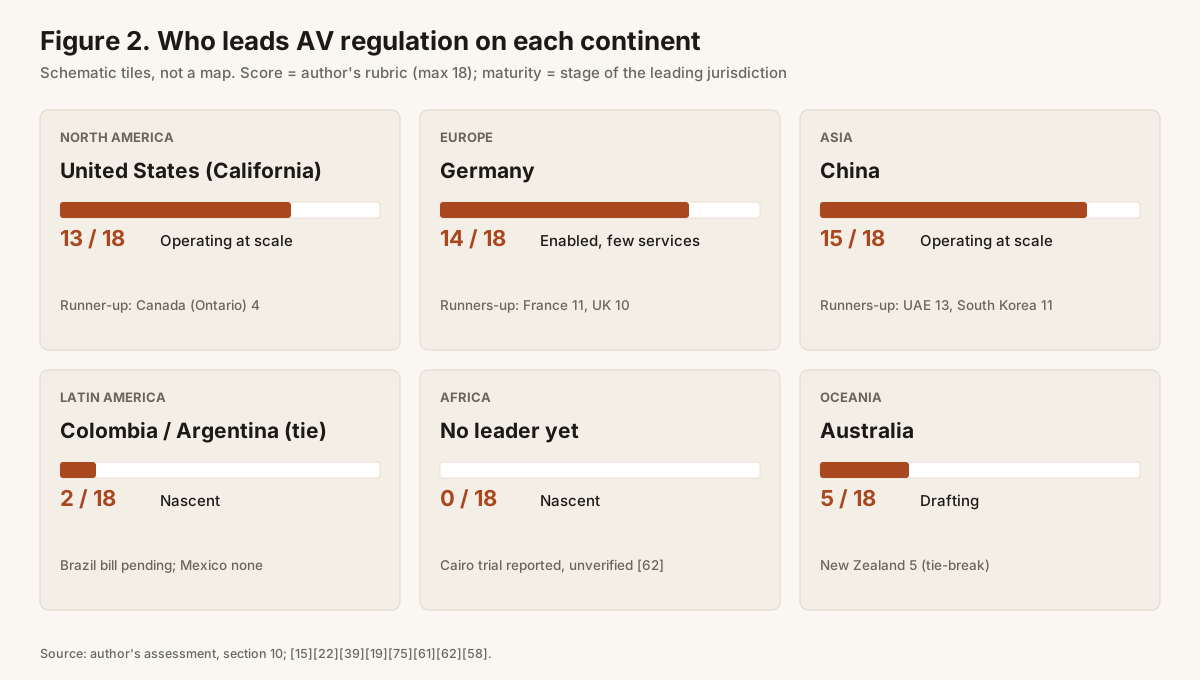 Figure 2. Leaders per continent with score and maturity. Source: author’s assessment.
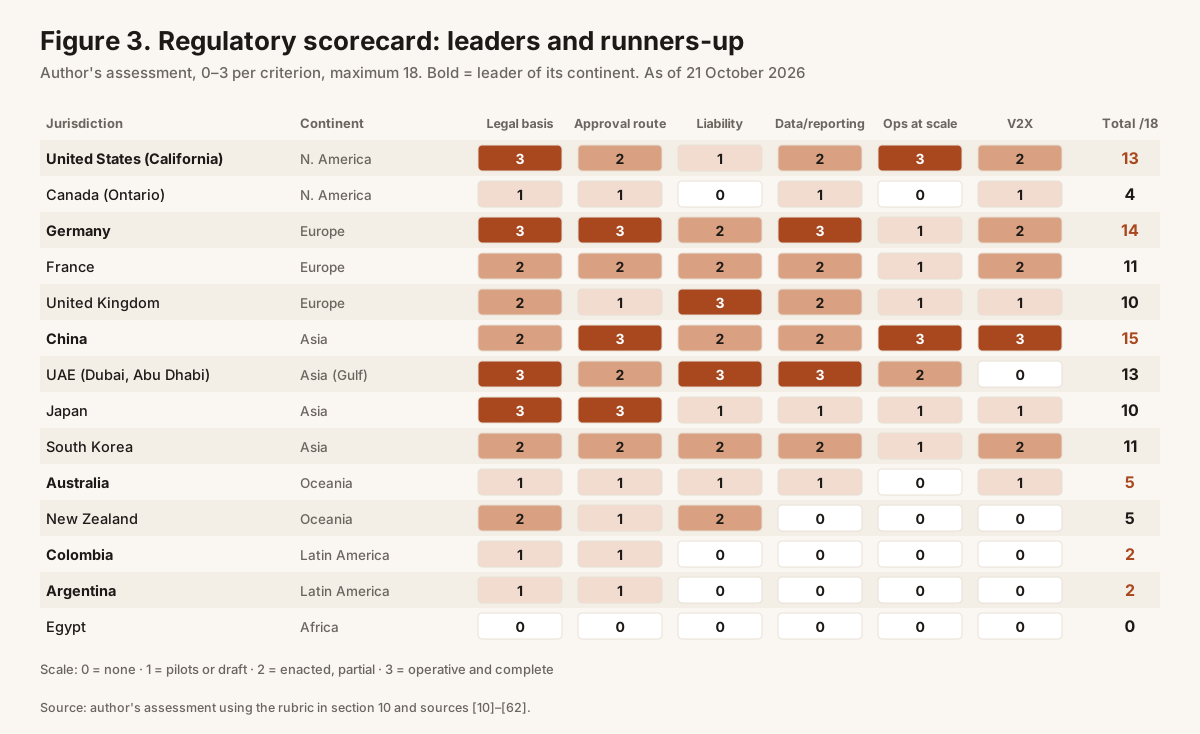 Figure 3. Leaders in bold. Within Asia the UAE (13) follows China; Japan drops to 10 because its liability and data rules could not be verified. Source: author’s assessment; sources as cited in sections 4–9.
| Continent | Leader | Score /18 | Why | Runner-up |
|---|---|---|---|---|
| Asia | China | 15 | National access route, mandatory L3/L4 standard from July 2027, draft law making makers liable, largest V2X base [33][36][39][40] | UAE 13 (strict operator liability, regulator telemetry); South Korea 11 |
| Europe | Germany | 14 | Operative L4 law with approval, supervision and data duties; scores 1 on operations [22] | France 11, UK 10 (strongest liability design, not yet in force) |
| North America | United States (California as most advanced state) | 13 | Driverless operation at scale, state permits, SGO; no federal statute and unsettled liability [10][15] | Canada 4 |
| Oceania | Australia | 5 | Exposure-draft bill with ADSE model; wins the tie-break over New Zealand [58] | New Zealand 5 |
| Latin America | Colombia / Argentina (tie) | 2 | Colombia regulates ADS up to Level 3; Argentina has federal traffic-law parameters; neither has liability rules [19][75] | Brazil (bill pending) |
| Africa | None | 0 | No AV statute found; the reported Cairo trial [62] is unverified and scores 0 | South Africa 0 |
How to read it. The scores measure how complete the legal framework is, not how good it is.
- The US scores high because operations are large and state law permits them, despite its federal gaps.
- Germany scores high on law but low on use.
- The UK’s liability design is the clearest in Europe. It scores lower only because most of the Act is not yet in force.
Figures 4 and 5 show the two dimensions where the differences matter most to agencies.
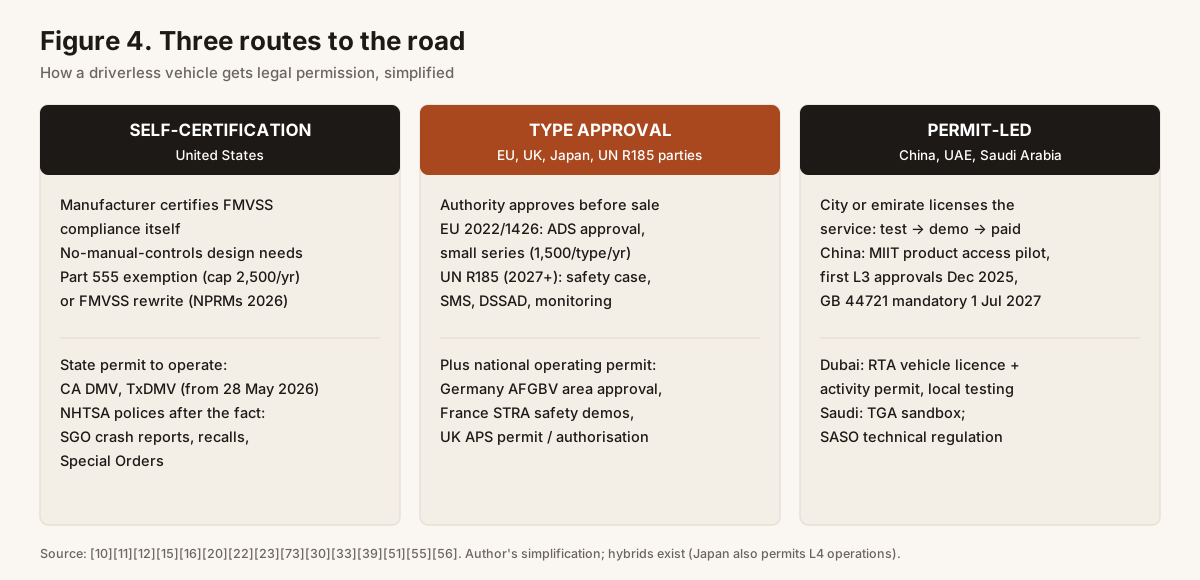 Figure 4. Self-certification, type approval and permit-led models. Source: [10]–[12][15][16][20][22][23][30][33][39][51][55][56][73].
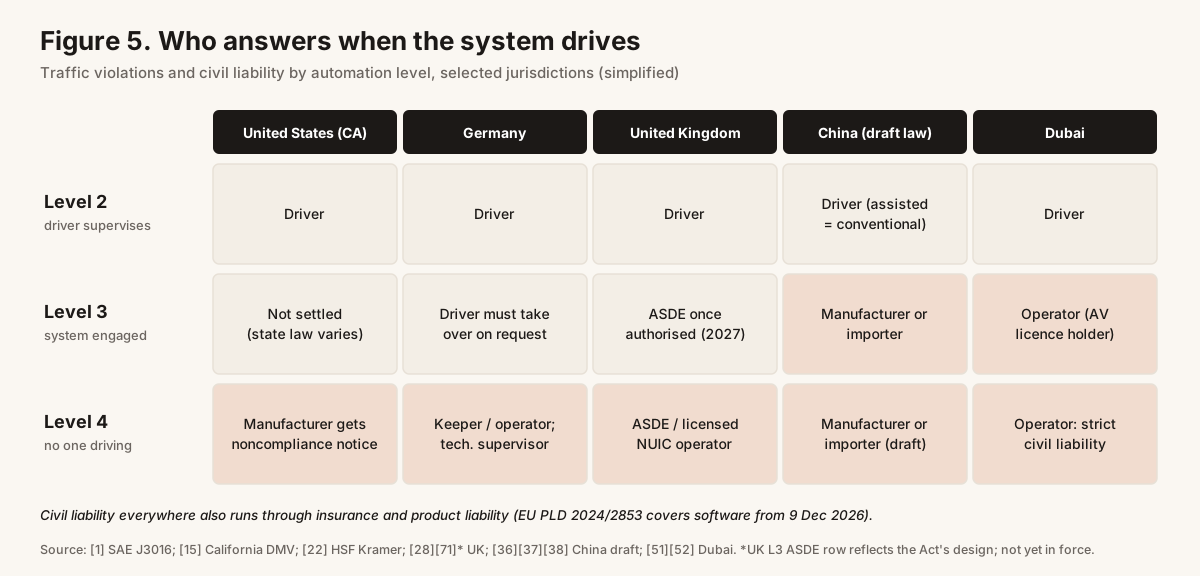 Figure 5. Responsibility shifts from driver to manufacturer or operator at Level 4 in every jurisdiction shown. Level 3 remains unsettled in the US. Source: [1][15][22][28][36][37][38][51][52][71].
11. Roadmap 2026–2030
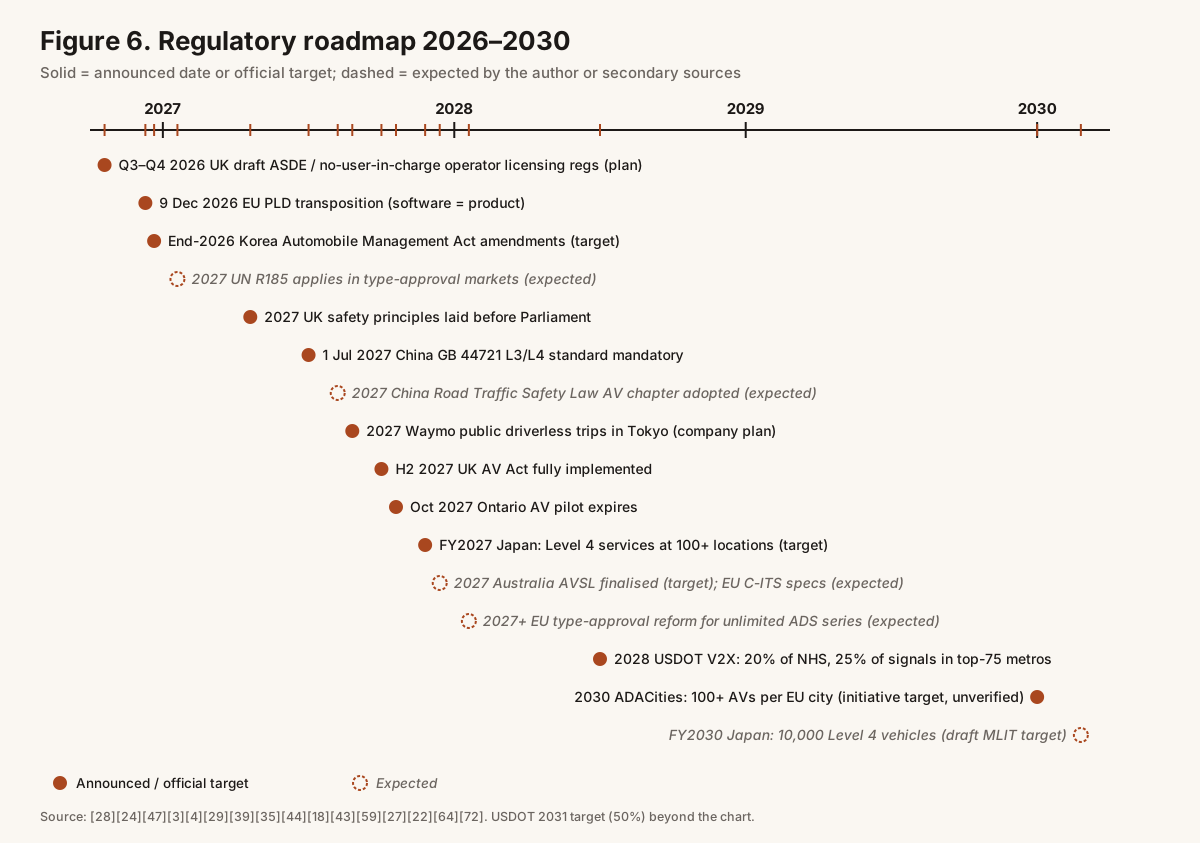 Figure 6. Most hard dates cluster in 2027. Source: as in the table.
| Date | Milestone | Status | Source |
|---|---|---|---|
| 9 Dec 2026 | EU Product Liability Directive transposition deadline (software = product) | Announced | [24] |
| End-2026 | Korea Automobile Management Act amendments for L4 | Announced target | [47] |
| Q3–Q4 2026 | UK draft regulations on ASDE and no-user-in-charge operator licensing | Announced plan (may slip) | [28] |
| 2027 | UN R185 applies in type-approval markets (EU, UK, Japan) | Expected; date unconfirmed | [3][4] |
| 2027 | UK statement of safety principles laid before Parliament | Announced | [29] |
| 1 Jul 2027 | China GB 44721—2026 L3/L4 safety standard mandatory | Announced | [39] |
| 2027 | China Road Traffic Safety Law AV chapter adopted | Expected (first reading Aug 2026) | [35] |
| H2 2027 | UK AV Act fully implemented | Announced | [28] |
| Oct 2027 | Ontario AV pilot expires; successor not announced | Announced | [18] |
| FY2027 | Japan: Level 4 services at 100+ locations | Official target (proposed for replacement) | [43] |
| 2027 | Waymo public driverless trips in Tokyo | Company plan | [44] |
| 2027 | Australia AVSL finalised | Official target | [59] |
| 2026–27 | EU binding C-ITS specifications | Expected | [27] |
| 2027+ | EU type-approval reform for unlimited ADS series | Expected | [22] |
| 2028 | USDOT V2X on 20% of the National Highway System and 25% of signalized intersections in the top 75 metros | Official target | [64] |
| 2030 | ADACities: 100+ AVs per participating EU city | Initiative target (not independently verified) | [22] |
| FY2030 | Japan: 10,000 Level 4 vehicles | Draft MLIT target | [72] |
| 2031 | USDOT V2X at 50% of both | Official target | [64] |
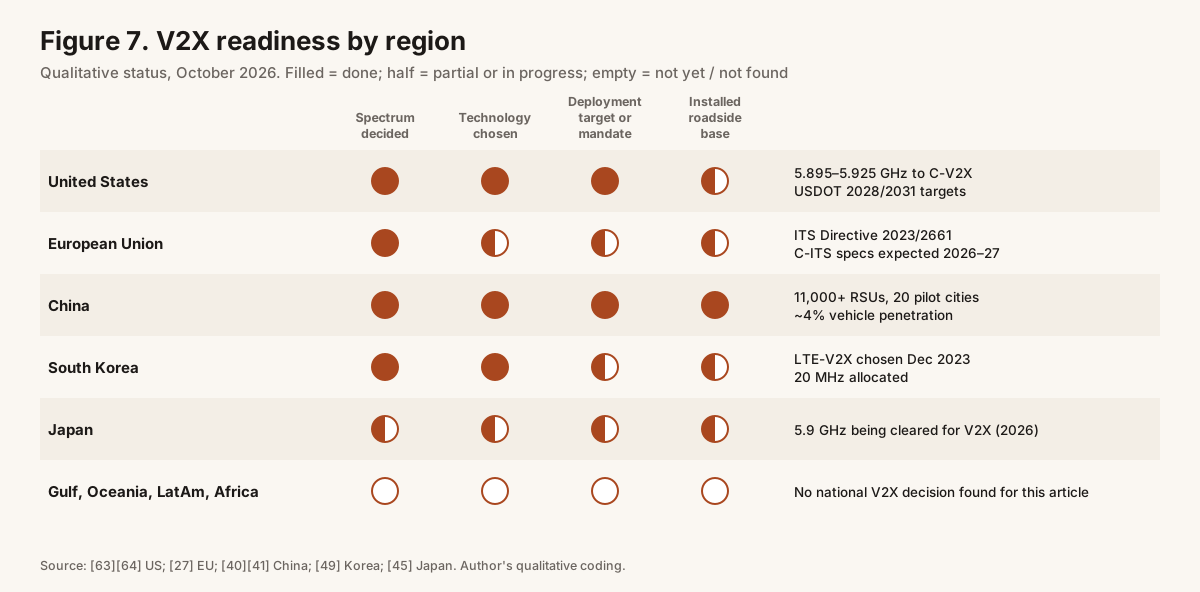 Figure 7. Only the US, China and Korea have a firm technology choice. Source: [27][40][41][45][49][63][64].
V2X in one paragraph.
- In the US, the FCC gave 5.895–5.925 GHz to C-V2X in November 2024 [63], and USDOT set the 2028 and 2031 targets [64].
- China has more than 11,000 roadside units but about 4% vehicle penetration [40].
- Korea chose C-V2X in December 2023, with 20 MHz for LTE-V2X Direct [49].
- Japan began clearing the 5.9 GHz band for V2X in 2026 [45].
- The EU still awaits binding C-ITS specifications [27].
What to watch.
- When UN R185 actually enters into force, and whether the EU uses it to lift the 1,500-unit cap.
- Whether China’s draft law keeps the burden of proof on manufacturers through second reading.
- NHTSA’s remote-assistance and first-responder dockets, and any movement on the Part 555 cap.
- The first UK APS permit and the first ASDE authorisation.
- Whether Ontario renews its pilot before October 2027.
- How Gulf permit regimes handle cross-emirate and cross-border operation.
12. What it means for road agencies and consultants
- Map the approval route before the proposal. In a self-certification country, the agency’s leverage sits in the operating permit and local conditions. In a type-approval country, it sits in the operating-area approval (Germany) or the service dossier (France).
- Write the traffic-law interface now. California’s noncompliance notices and China’s draft rule both send violations to the manufacturer [15][36]. Agencies need a process: who issues the notice, to whom, with what evidence and what response time.
- Ask for the data the law will require anyway. DSSAD records under R185, SGO reports in the US, and Dubai’s RTA-controlled logs [2][10][51] show what will become standard. Ask for exposure-based rates matched to the ODD.
- Specify remote-operation expectations. Germany requires a technical supervisor, France a remote intervenor, Korea real-time monitoring [22][23][47]. In answers to a Senate inquiry, Waymo reported about 70 remote assistance agents for about 3,000 vehicles in early 2026 [65]. Where the law is silent, put staffing, response times and recovery procedures into the permit.
- Plan V2X on the national track. In the US, procure C-V2X in the 30 MHz band. In Europe, align with C-ITS specifications as they arrive.
- Treat 2027 as the planning year. R185, the UK Act, China’s GB 44721 and the Ontario expiry all fall in 2027.
- Budget for independent review. A transatlantic comparison of approvals is often the fastest way to test whether a proposal is complete. See technical review and US–Italy practice.
13. Limitations
- Scores are judgement. The rubric is transparent but coarse. A 0–3 scale cannot capture the quality of a law, only how complete and operative it is.
- Unverified items:
- R185’s entry-into-force date (one headline says January 2027 [70]);
- the Saudi SASO regulation and Interior Ministry statement [56];
- the Cairo trial [62];
- Japanese liability and data-recording rules, and Japanese and Korean rules on who gets the ticket (Japan is scored conservatively);
- the detail of Germany’s remote-driving permit route;
- how far ISO 34502, ISO 21448 and UL 4600 are referenced in R185.
- Dated counts. The 19-state US count is from 2024 [17].
- Secondary sources. Many facts come from law-firm summaries rather than the legal texts. Treat them as accurate summaries, not the law itself.
- Fast change. Several of the milestones in section 11 could slip. The UK has already moved its implementation once, to late 2027 [71].
14. Checklist for agencies and practitioners
- Identify which approval model applies: self-certification, type approval or permit-led.
- List every ADS permit on your network with its ODD, fleet cap and expiry date.
- Confirm who receives traffic violations by driverless vehicles, and set up the notice process.
- Check whether the operator, the manufacturer or the insurer pays first after a crash, and what evidence they must disclose.
- Require DSSAD-type event records and periodic exposure-based safety reports.
- Require remote-operation details: staffing ratio, location, response time and on-site recovery.
- Agree emergency-geofence and first-responder protocols. California’s two-minute rule is a useful benchmark [15].
- Align V2X procurement with national spectrum and technology decisions.
- Track the 2027 milestones (R185, UK Act, GB 44721, Ontario) in your programme risk register.
- Re-score your jurisdiction against the rubric every six months.
For an independent review of an AV or V2X proposal on your network, see peer review or get in touch.
Sources
- SAE International. J3016_202104 Taxonomy and Definitions for Terms Related to Driving Automation Systems, revised 30 Apr 2021. https://saemobilus.sae.org/content/j3016_202104
- Bennett Jones. “First global regulatory framework for autonomous vehicles: key takeaways for Canada and the auto industry”, Aug 2026. https://www.bennettjones.com/Insights/Blogs/2026/08/First-Global-Regulatory-Framework-For-Autonomous-Vehicles
- Shoosmiths (B. Gardner). “UN automated driving regulation: A step change for global AV use”, 7 Jul 2026. https://www.shoosmiths.com/perspectives/stories/articles/un-automated-driving-regulation-a-step-change-for-global-av-use
- Applied Intuition. “The end of fragmented AV regulation”, 13 May 2026. https://www.appliedintuition.com/blog/un-av-regulation-framework-oems
- Arnold NextG. “New Global ADS Regulations”, 21 Jul 2026. https://www.arnoldnextg.com/company/blog/new-global-ads-regulations
- carhs. “UN R185 & UN GTR 26” seminar description, accessed Oct 2026. https://www.carhs.de/en/seminar/212
- Motor1 France (A. Carmone). “Conduite autonome en Europe, ce qui change à partir du 14 juillet”, 6 Jul 2022. https://fr.motor1.com/news/596201/conduite-autonomie-loi-europe/
- Wikipedia. “Vienna Convention on Road Traffic”, accessed Oct 2026. https://en.wikipedia.org/wiki/Vienna_Convention_on_Road_Traffic
- Wikipedia. “Automated lane keeping systems” (citing UNECE press releases 2020, 2022). https://en.wikipedia.org/wiki/Automated_lane_keeping_systems
- Crowell & Moring. “NHTSA announces first actions under Trump administration’s new framework…”, 28 Apr 2025. https://www.crowell.com/en/insights/client-alerts/nhtsa-announces-first-actions-under-trump-administrations-new-framework-for-removing-regulatory-barriers-for-automated-vehicles
- Sidley Austin. “NHTSA announces a host of actions on autonomous vehicles”, Aug 2026. https://environmentalhealthsafetybrief.sidley.com/2026/08/04/nhtsa-announces-a-host-of-actions-on-autonomous-vehicles/
- Covington (Inside Global Tech). “Federal Vehicle Safety at Midyear: Regulatory Relief, Legislative Momentum, and the Road to the Broader AV Deployment”, 29 Jun 2026. https://www.insideglobaltech.com/2026/06/29/federal-vehicle-safety-at-midyear-regulatory-relief-legislative-momentum-and-the-road-to-the-broader-av-deployment/
- Crowell & Moring. “NHTSA proposes AV brake standard updates and withdraws AV STEP program”, 2 Jul 2026. https://www.crowell.com/en/insights/client-alerts/nhtsa-proposes-updates-to-federal-brake-standards-for-autonomous-vehicles-and-withdraws-av-step-program
- FutureSearch. “Will federal autonomous vehicle legislation be signed by January 2027?”, accessed Oct 2026. https://futuresearch.ai/app/p/a/federal-av-legislation-signed-by-january-2027
- Covington & Burling (Global Policy Watch). “California’s new AV rules open door to heavy-duty deployment…”, Jun 2026. https://www.globalpolicywatch.com/2026/06/californias-new-av-rules-open-door-to-heavy-duty-deployment-while-imposing-significant-new-compliance-obligations/
- Texas DMV. “Texas begins enforcement of commercial automated vehicle requirements”, 2 Jun 2026. https://content.govdelivery.com/accounts/txdmv/bulletins/419ec36
- Baker Donelson. “Autonomous Vehicle Statutes and Regulations Across the 50 States”, 20 Sep 2024. https://www.bakerdonelson.com/autonomous-vehicle-statutes-and-regulations-across-the-50-states
- Canadian Affairs. “A future of driverless rides draws closer”, 9 Oct 2026. https://www.canadianaffairs.news/2026/10/09/a-future-of-driverless-rides-draws-closer/
- FAS Advogados / CMS (R. de Castro Sardenberg). “Liability and the regulation for autonomous driving in Latin America”, 9 Mar 2026. https://fasadv.com.br/en/bra/publication/cms-automotive-outlook-2026/liability-and-the-regulation-for-autonomous-driving-in-latin-america
- Kraftfahrt-Bundesamt. “EU type approvals for motor vehicles with a fully automated driving function in small series production”, accessed Oct 2026. https://www.kba.de/EN/Themen_en/Typgenehmigung_en/Autonomes_automatisiertes_Fahren_en/EU_Typgenehmigung_en/eu_typgenehmigung_node_en.html
- EUR-Lex. Commission Implementing Regulation (EU) 2026/481 of 3 Mar 2026 amending Regulation (EU) 2022/1426. https://eur-lex.europa.eu/eli/reg_impl/2026/481/oj/eng ; summary: ROAT Observatory. https://roat.sk/sources/roat-2026-0218/
- Herbert Smith Freehills Kramer. “Autonomous vehicles in Germany: regulatory framework and key developments”, 6 Oct 2026. https://www.hsfkramer.com/insights/2026-10/autonomous-vehicles-in-germany-regulatory-framework-and-key-developments
- Banque des Territoires. “Véhicules à délégation de conduite: le cadre réglementaire est fixé”, 5 Jul 2021. https://www.banquedesterritoires.fr/vehicules-delegation-de-conduite-le-cadre-reglementaire-est-fixe
- Reed Smith. “The new EU Product Liability Directive: key implications for the autonomous vehicle sector”, 20 Oct 2025. https://www.reedsmith.com/en/perspectives/2025/10/the-new-eu-product-liability-key-implications-autonomous-vehicle
- Regulation (EU) 2024/1689 (AI Act), Article 109, via Springlex. https://www.springlex.eu/en/packages/ai-act/ai-act-regulation/article-109/
- Council of the EU. Information from the Commission on a large-scale cross-border AV testbed initiative, doc. 9848/26, 3 Jun 2026. https://www.parlament.gv.at/dokument/XXVIII/EU/75384/imfname_11625770.pdf
- Eastgate Software (H. Bui). “EU C-ITS 2027 mandate”, 25 Mar 2026. https://eastgate-software.com/insights/eu-cits-2027-mandate/
- Hogan Lovells. “Automated Vehicles in the UK: What’s coming down the road in 2026?”, 29 Jan 2026. https://www.hlc.com/en/publications/automated-vehicles-in-the-uk-whats-coming-down-the-road-in-2026
- GOV.UK. “New consultation on draft statutory statement of safety principles for automated vehicles”, 17 Jun 2026. https://www.gov.uk/government/speeches/new-consultation-on-draft-statutory-statement-of-safety-principles-for-automated-vehicles
- The Next Web. “Britain built a legal route to driverless taxis in May. London’s first robotaxi service did not use it”, 4 Sep 2026. https://thenextweb.com/news/london-robotaxi-phv-route-aps-permit-unused
- Beijing Municipal Government. “Beijing passes regulations to support, govern autonomous driving technologies”, 2 Jan 2025. https://english.beijing.gov.cn/latest/news/202501/t20250102_3978829.html
- Gasgoo. “China approves nine automakers for L3 intelligent connected vehicle pilot program”, 6 Jun 2024. https://autonews.gasgoo.com/articles/icv/china-approves-nine-automakers-for-l3-intelligent-connected-vehicle-pilot-program-70033401
- CnEVPost. “China grants 1st L3 autonomous driving permits for regular passenger cars”, 15 Dec 2025. https://cnevpost.com/2025/12/15/china-grants-1st-l3-autonomous-driving-permits-passenger-cars/
- CnEVPost. “China puts brakes on chaos in smart driving sector”, 17 Apr 2025. https://cnevpost.com/2025/04/17/china-puts-brakes-chaos-smart-driving/
- China Daily. “Updated autonomous vehicle rules mooted”, 26 Aug 2026. https://www.chinadaily.com.cn/a/202608/26/WS6a8e3d5be4b06d4aa055a742.html
- Sixth Tone. “China Moves to Address Self-Driving Cars in National Law”, Aug 2026. https://www.sixthtone.com/news/1018990
- Yicai Global. “China Revises Road Traffic Safety Law, Shifting Self-Driving Liability to Carmakers”, 26 Aug 2026. https://www.yicaiglobal.com/news/china-revises-its-road-traffic-safety-law-to-include-self-driving
- GMT Eight. “China’s Draft Traffic Law Redraws Liability for the Driverless Era”, 28 Aug 2026. https://gmteight.com/content/detail/425626
- CnEVPost. “China sets unified safety baseline for L3, L4 autonomous driving”, 4 Aug 2026. https://cnevpost.com/2026/08/04/china-sets-safety-baseline-l3-l4-autonomous-driving/
- TechInsights. “China C-V2X: Policy ambition meets commercial reality”, 4 Mar 2026. https://www.techinsights.com/ja/node/61168
- Caixin Global. “Vehicle-road-cloud integration pilot program to include 20 cities”, 4 Jul 2024. https://www.caixinglobal.com/2024-07-04/vehicle-road-cloud-integration-pilot-program-to-include-20-cities-102212883.html
- METI (Japan). Level 4 approval press release, 31 Mar 2023. https://www.meti.go.jp/english/press/2023/0331_003.html
- MLIT (T. Naono). “Japan’s Efforts to Promote Automated/Autonomous Driving, Including Robotaxis”, JASIC symposium, 18 Apr 2025. https://www.jasic.org/meeting_docs_admin/contents/uploads/doc/meeting3/2.Japan%E2%80%99s%20Efforts%20to%20Promote%20Automated%20Autonomous%20Driving,%20Including%20Robotaxis.pdf
- Just Auto. “Waymo to launch robotaxi service in Japan in 2027”, 16 Sep 2026. https://www.just-auto.com/news/waymo-to-launch-robotaxi-service-in-japan-in-2027/
- MIC (Japan). Press release on designation of a frequency-change response body for the 5.9 GHz band (V2X), 11 Mar 2026. https://www.soumu.go.jp/main_sosiki/joho_tsusin/eng/pressrelease/2026/3/11_6.html
- International Bar Association. “Recent trends in regulations on autonomous vehicles in Korea”, c. 2020. https://www.ibanet.org/article/19FCDD11-A0B1-41F1-97AB-F32E144311F8
- STARNEWS Korea. “MOLIT announces ‘driving record focus’ in guidelines for safety operation requirements of Level 4 unmanned autonomous vehicles”, 8 Jul 2026. https://www.starnewskorea.com/en/business-life/2026/07/08/2026070811484356813
- ITIF (R. D. Atkinson, S. Kim). “Korea Needs to Fix Mobility Market Before Robotaxis Arrive”, 27 Apr 2026. https://itif.org/publications/2026/04/27/korea-needs-to-fix-mobility-market-before-robotaxis-arrive/
- 5GAA. “The Republic of Korea Picks C-V2X as its Technology of Choice”, 12 Dec 2023. https://5gaa.org/the-republic-of-korea-picks-c-v2x-as-its-technology-of-choice/
- Land Transport Authority (Singapore). “Autonomous shuttle services in Punggol open for public rides”, 4 Mar 2026. https://www.lta.gov.sg/content/ltagov/en/newsroom/2026/3/news-releases/autonomous-shuttle-services-in-punggol-open-for-public-rides-fro.html
- Bracewell. “Driverless in the UAE, two years on: from roads to waterways and beyond”, 11 Aug 2026. https://www.bracewell.com/resources/driverless-in-the-uae-two-years-on-from-roads-to-waterways-and-beyond/
- PwC Middle East. “Dubai Autonomous Vehicle (AV) Law and recent regulatory developments”, 18 Feb 2026. https://www.pwc.com/m1/en/services/tax/middle-east-tax-news-alerts/2026/dubai-autonomous-vehicle-law.html
- Dubai Media Office. “RTA launches autonomous taxi services via Uber and Apollo Go”, 30 Mar 2026. https://mediaoffice.ae/en/news/2026/march/30-3/rta-launches-commercial-operations-involving-autonomous-taxis
- TechCrunch. “Uber and WeRide’s robotaxi service in Abu Dhabi is officially driverless”, 25 Nov 2025. https://techcrunch.com/2025/11/25/uber-and-werides-robotaxi-service-in-abu-dhabi-is-officially-driverless
- Al Tamimi & Company. “Driving into the Future: Regulatory Updates on AVs in the Kingdom of Saudi Arabia”, Dec 2025. https://www.tamimi.com/law-update-articles/driving-into-the-future-regulatory-updates-on-avs-in-the-kingdom-of-saudi-arabia/
- Tech Times. “Saudi Arabia legalized driverless trucks nationally; now HUMAIN deploys camera-radar L4 fleet”, 1 Sep 2026. https://www.techtimes.com/articles/326250/20260901/saudi-arabia-legalized-driverless-trucks-nationally-now-humain-deploys-camera-radar-l4-fleet.htm
- Department of Infrastructure, Transport, Regional Development, Communications and the Arts (Australia). “Automated vehicles”, accessed Oct 2026. https://www.infrastructure.gov.au/infrastructure-transport-vehicles/transport-strategy-policy/office-future-transport-technology/automated-vehicles
- FCAI. “Limited exposure draft of Automated Vehicle Safety Bill 2026”, 16 Sep 2026. https://www.fcai.com.au/limited-exposure-draft-of-automated-vehicle-safety-bill-2026/
- Information Age (D. Braue). “Govt won’t finalise self-driving car rules until 2027”, 24 Oct 2025. https://ia.acs.org.au/article/2025/govt-won-t-finalise-self-driving-car-rules-until-2027.html
- Ministry of Transport (New Zealand). “Current regulatory settings for autonomous vehicles”, accessed Oct 2026. https://transport.govt.nz/about-us/what-we-do/queries/current-regulatory-settings-for-autonomous-vehicles
- TopAuto (W. Hawkins). “No autonomous cars for South Africa just yet”, 28 Mar 2026. https://topauto.co.za/features/147075/no-autonomous-cars-for-south-africa-just-yet/
- AF.net. “Baidu Apollo to launch robotaxi trials in Cairo by October 2026”, 27 Sep 2026 (single secondary source). https://af.net/realtime/baidu-apollo-to-launch-robotaxi-trials-in-cairo-by-october-2026-2/
- Venable LLP. “FCC adopts final rules on C-V2X in 5.9 GHz for auto safety”, Nov 2024. https://www.venable.com/insights/publications/2024/11/fcc-adopts-final-rules-on-c-v2x-in-5-9-ghz-for
- Covington & Burling (Inside Global Tech). “USDOT releases plan to accelerate V2X deployment”, 30 Aug 2024. https://www.covingtonblogs.com/2024/08/30/usdot-releases-plan-to-accelerate-v2x-deployment/
- Axios. “Senator calls for federal oversight of remote helpers for autonomous vehicles”, 31 Mar 2026. https://www.axios.com/2026/03/31/autonomous-vehicles-remote-av-federal-markey
- Automotive World (S. Burnett). “BMW drops Level 3 ADAS as industry backing ebbs away”, 24 Feb 2026. https://www.automotiveworld.com/news/bmw-drops-level-3-adas-as-industry-backing-ebbs-away/
- Electrek (F. Lambert). “NHTSA orders Tesla to prove its Cybercab is legal to sell, under oath”, 15 Sep 2026. https://electrek.co/2026/09/15/nhtsa-tesla-cybercab-special-order-fmvss-certification/
- Digitimes. “China halts new autonomous driving permits after Baidu Apollo Go robotaxi failure”, 30 Apr 2026 (unconfirmed). https://www.digitimes.com/news/a20260429PD234/baidu-robotaxi-autonomous-driving-china.html
- CarNewsChina. “China robotaxi industry faces regulatory ‘cooling-off’ following March Apollo Go mass paralysis”, 29 May 2026. https://carnewschina.com/2026/05/29/china-robotaxi-industry-faces-regulatory-cooling-off-following-march-apollo-go-mass-paralysis/
- Yahoo News. “UN enforces global safety rules for fully autonomous vehicles, effective January 2027” (headline only; not verified). https://www.yahoo.com/news/science/articles/un-enforces-global-safety-rules-134507905.html
- Wikipedia. “Automated Vehicles Act 2024”, accessed Oct 2026. https://en.wikipedia.org/wiki/Automated_Vehicles_Act_2024
- Automotive World. “Japan targets 10,000 AVs on roads by 2030”, 4 Nov 2025. https://www.automotiveworld.com/articles/japan-targets-10000-avs-on-roads-by-2030/
- STRMTG (France). “The French regulatory framework for automated road transport systems”, accessed Oct 2026. https://www.strmtg.developpement-durable.gouv.fr/en/the-french-regulatory-framework-for-automated-road-a167.html
- Banque des Territoires. “Véhicules à délégation de conduite: l’ordonnance sur le régime de responsabilité pénale publiée”, Apr 2021 (Ordonnance n° 2021-443 of 14 Apr 2021). https://www.banquedesterritoires.fr/vehicules-delegation-de-conduite-lordonnance-sur-le-regime-de-responsabilite-penale-publiee
- Diario de Cuyo. “El Gobierno modificó la Ley Nacional de Tránsito: los cambios que deberán tener en cuenta” (Decreto 196/2025), Mar 2025. https://www.diariodecuyo.com.ar/argentina/el-gobierno-modifico-la-ley-nacional-de-transito-los-cambios-que-deberan-tener-en-cuenta-1713200.html
- Automotive World (S. Burnett). “Zoox wins US approval to deploy 5,000 driverless robotaxis”, 30 Jul 2026. https://www.automotiveworld.com/news/zoox-wins-us-approval-to-deploy-5000-driverless-robotaxis/
Need this applied to your corridor?
Send the study scope and the data you have. You will get a reply within two working days.
Discuss a project